
There is a one-bedroom apartment in Jumeirah Village Circle you can buy for AED 750,000. There is another one-bedroom apartment in Downtown Dubai, roughly the same floor area, that will cost you AED 2.2 million. Both are freehold. Both are finished to a reasonable standard. Both will find a tenant within weeks of listing. Yet the price gap between them is nearly three times. If you are trying to understand Dubai real estate without understanding why that gap exists, you are working with an incomplete picture.
Dubai is not one property market. It is a collection of distinct micro-markets operating under the same regulatory framework but driven by entirely different forces. Location, infrastructure maturity, transport access, developer reputation, supply dynamics, and the legal structure of ownership all feed into the price of any given apartment. The result is a city where the cost of apartments in Dubai can span from AED 500 per square foot in an outer district to over AED 10,000 per square foot in a trophy asset on Jumeirah Bay Island. That is not volatility or irrationality. It is a market doing exactly what markets do: pricing the sum of every advantage a property holds relative to everything else available.
Understanding those advantages, and how they compound or cancel each other out depending on the district, is what separates buyers who make confident decisions from those who overpay in the wrong place or underpay their way into a property they cannot exit.
The Geography of Price: Why Location Still Drives Everything
Dubai’s residential districts did not develop uniformly. The city grew outward from its historic centre along the creek, expanding down Sheikh Zayed Road, then fanning into master-planned communities across what was, not long ago, open desert. The result is a city with enormous variation in how mature, how connected, and how desirable different areas feel to the people who live and invest in them.
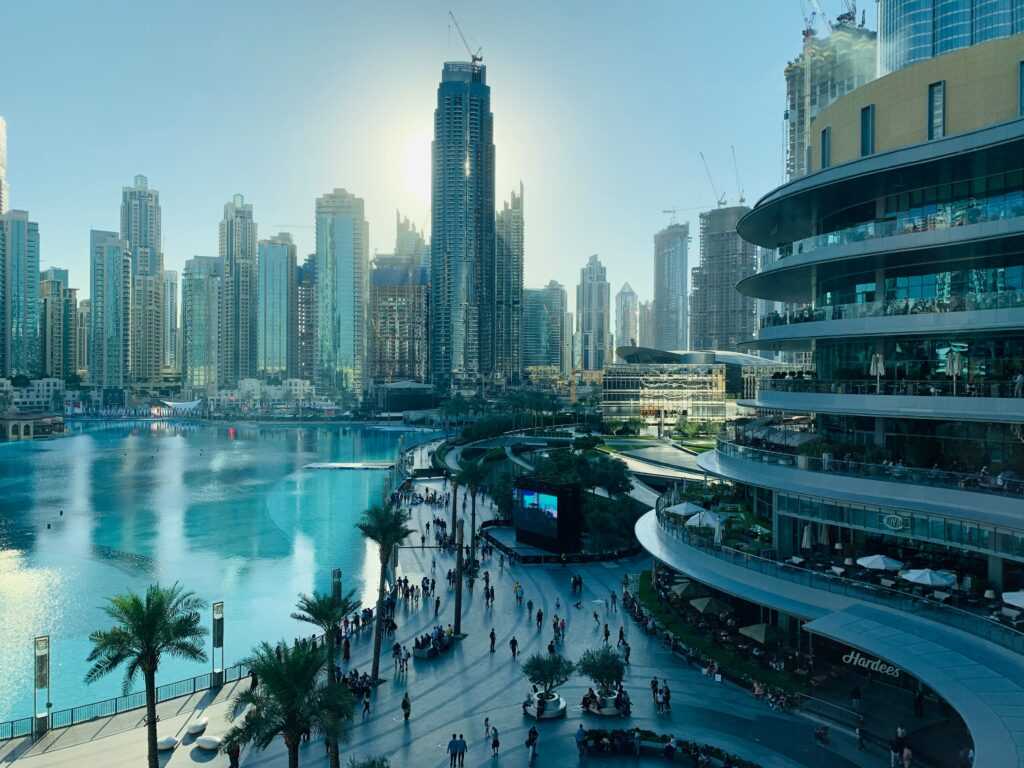
Downtown Dubai sits at the geographic and psychological centre of modern Dubai. It has the Burj Khalifa, the Dubai Mall, the Dubai Fountain, and the kind of brand recognition that translates directly into property demand from buyers in over 100 countries. As of mid-2026, the average price per square foot in Downtown Dubai is approximately AED 2,980, according to transaction data sourced through the Dubai Land Department. That figure does not reflect excess or speculation. It reflects the reality that Downtown has a finite supply of apartments, a density of amenities that no other district in the city has fully replicated, and a tenant base that is consistently high-income.
Dubai Marina operates on a similar logic. Its waterfront configuration, walkability, and metro connectivity have made it the city’s most consistently popular district for both investors and residents for over a decade. The average price per square foot there currently sits at AED 2,061, roughly two-thirds of Downtown’s rate, which reflects the fact that Marina has considerably more supply and more buildings competing for the same pool of buyers.
Move out to Business Bay, which borders Downtown along the Dubai Canal, and the average sits at around AED 2,673 per square foot. Business Bay benefits directly from its proximity to DIFC and the Downtown corridor while offering a wider range of tower quality and a larger overall supply. That variation within Business Bay is itself significant: a premium canal-facing tower in Business Bay and an older inland tower in the same district can differ by AED 600 per square foot, which reflects how granular Dubai’s pricing actually is beneath the district-level averages.
Then there is Jumeirah Village Circle, which consistently records some of the highest rental yields in the city at 7% to 9.5%, but where purchase prices remain accessible because the area is further from the metro network and lacks the lifestyle infrastructure of waterfront communities. Affordability and yield attract investors. The absence of metro access and marina lifestyle keeps prices from climbing to Downtown levels.
This spatial hierarchy is not static. It shifts as infrastructure changes, as new master developments alter the supply picture, and as the city’s population centres of gravity move. But the underlying logic remains: proximity to employment hubs, retail, entertainment, and transport commands a premium, and distance from those things produces a discount.
The Metro Effect: Infrastructure That Reprices Entire Neighbourhoods
No single piece of infrastructure has done more to reshape Dubai’s residential pricing geography than the metro. When the Red Line opened in 2009, it did not just move people. It fundamentally repriced the areas it connected. Between 2010 and 2022, property prices near Red Line stations climbed 26.7%, outpacing the 24.1% citywide average over the same period. Rental rates in those areas rose even during periods when overall rents were declining across Dubai.
The data on metro proximity is consistent and substantial. Apartments located near metro stations command up to 30% higher rents than comparable units slightly further away, a premium rooted not in perception but in the genuine reduction of transportation cost and commute time for residents. In a city where roughly 90% of residents are expatriates, many of whom do not own cars when they first arrive, proximity to the metro is a material quality-of-life factor that the rental market prices accordingly.
The upcoming Blue Line, a 30-kilometre route with 14 stations scheduled for completion in 2029, is already influencing prices along its corridor. Dubai Silicon Oasis posted a price-per-square-foot increase of up to 29% in 2025, partly attributed to its inclusion in the Blue Line corridor. Areas like Arjan, Al Furjan, and Academic City are drawing investor attention precisely because the metro connection that will reprice them does not yet exist. Investors who have studied the Red Line precedent are positioning themselves ahead of the same curve.
The Roads and Transport Authority has confirmed that residential real estate located within 1 to 5 kilometres of existing metro stations has historically appreciated between 13% and 41% more than properties outside that corridor. That is a range, not a guarantee, and it depends heavily on what else the location offers. But it establishes clearly that metro access is a structural advantage that feeds directly into apartment pricing.
Developer Reputation and What the Brand Behind a Building Actually Costs
Two buildings can stand in the same district, at roughly the same address, and carry significantly different prices per square foot because of who built them. In Dubai, developer reputation is not a soft factor. It is a measurable price driver.
Emaar Properties, which developed Downtown Dubai and Dubai Hills Estate among others, consistently commands a premium over comparable inventory from smaller or less established developers. Buyers purchasing Emaar pay for a track record of delivery, a commitment to community maintenance, and a secondary market that is reliably liquid because other buyers recognise the name. That recognition has tangible financial value.
The most extreme expression of developer-driven pricing in Dubai is the branded residence segment. In 2025, branded residences commanded an average price of AED 3,288 per square foot, a 42% premium over non-branded properties at AED 2,321 per square foot, according to data from Morgan’s International Realty. At the extreme end, Bulgari Residences on Jumeirah Bay Island traded at AED 10,668 per square foot. Atlantis Residences reached AED 9,387. The Dorchester Collection achieved AED 7,539.
These are not simply expensive apartments. They are a category of asset where the brand name, whether a hotel group, a fashion house, or an automotive marque, functions as a guarantee of design quality, service standards, and resale liquidity. Buyers are willing to pay premiums of between 40% and 60% over non-branded equivalents precisely because the brand reduces the uncertainty around what they are getting and who will buy it from them in the future.
Dubai now leads the world in the volume of branded residences under development, with 144 active projects and 48,474 branded units in the pipeline as of mid-2025. In 2024 alone, 13,000 branded residences transacted for a combined AED 60 billion, representing 8.5% of total real estate transaction value in the city. For investors comparing two apartments at similar addresses, the presence or absence of a recognised brand affiliation is a legitimate and significant pricing factor.
Supply and Demand at the District Level: Where the Numbers Tell a Different Story
City-wide supply figures can obscure what is actually happening within any specific district, and that gap between the macro picture and the micro reality is where pricing gets genuinely interesting.
Dubai’s pipeline includes approximately 366,000 residential units projected for delivery by 2028. That headline figure, quoted frequently, creates an impression of supply abundance that can mislead buyers who do not look closely enough at where those units are actually concentrated. The overwhelming majority of new supply is landing in outer districts and emerging communities: Dubai South, Dubailand, and the areas surrounding the Expo City corridor. Downtown Dubai, Dubai Marina, and Palm Jumeirah have essentially exhausted their development land. New supply in those districts is limited to individual plot redevelopments and occasional demolition and rebuild projects, which keeps pricing elevated through scarcity.
JVC, by contrast, has seen sustained new development for the better part of a decade. That ongoing supply is one reason prices have remained accessible compared to waterfront communities, even as rental yields remain strong. New buildings compete with each other for tenants, which moderates rent growth but keeps occupancy high given the district’s affordability advantages. For investors, the implication is clear: JVC’s yield story depends on competitive positioning within a supply-rich environment, which requires active management of the asset.
The areas where supply is tightest relative to demand tend to be the areas where prices have appreciated most sharply. Villa communities like Arabian Ranches, which cannot expand because they are fully built, and Palm Jumeirah, where the frond configuration physically caps the number of units, have seen the strongest price growth of any residential format in Dubai over the past three years. The same logic applies to premium apartments in districts with constrained land.
Service Charges: The Hidden Cost That Changes the Real Price of Any District
Purchase price per square foot is how districts get compared. Net yield after costs is how investments actually perform. The difference between those two figures depends significantly on service charges, a factor that most buyers underweight until they are already committed.
Service charges in Dubai are annual fees levied per square foot of built-up area, regulated by RERA and published through the DLD Service Charge Index. They cover common area maintenance, security, waste management, and in many buildings, central district cooling. Rates vary enormously across districts and buildings.
In Dubai Marina and Downtown Dubai, annual service charges for apartments typically range from AED 14 to AED 28 per square foot. On a 1,000-square-foot apartment, that is AED 14,000 to AED 28,000 per year in mandatory recurring costs before mortgage payments, management fees, or vacancy periods are considered. For a branded residence with hotel-level amenities and concierge services, charges can exceed AED 40 per square foot annually, which represents a substantial ongoing commitment for an investor calculating net returns.
In more affordable districts like JVC and Jumeirah Lake Towers, service charges tend to run between AED 10 and AED 18 per square foot, reflecting lower amenity intensity and different management structures. A 1,200-square-foot apartment in JLT at AED 15 per square foot carries an annual service charge of AED 18,000, which as a percentage of rental income is considerably lower than the equivalent calculation in a premium Downtown tower.
RERA’s annual Service Charge Index is publicly accessible through the DLD website and the Dubai REST application. Every serious buyer should verify the approved rate for any specific building before completing due diligence, because two apartments in the same district can carry very different service charge obligations depending on the building’s age, amenity level, and management company. The impact on net yield is not marginal. Service charges typically consume between 15% and 25% of gross rental income in well-maintained apartment buildings.
Freehold Zoning and What Ownership Structure Does to Pricing
Not every district in Dubai permits foreign ownership, and the distinction between freehold and leasehold areas has a direct and measurable effect on pricing.
Freehold zones, of which there are now over 60 across the emirate, permit any nationality to purchase property with full title, the right to sell or lease freely, and the ability to pass the asset to heirs. Leasehold areas restrict foreign ownership to a tenure of typically 99 years, without the same degree of title security or inheritance certainty. For international investors, particularly those from markets where long-term property rights are less secure, the freehold designation provides a level of comfort that they price into their willingness to pay.
All of Dubai’s premium residential districts, including Downtown Dubai, Dubai Marina, Palm Jumeirah, Business Bay, and JVC, are designated freehold zones. Properties in these areas are eligible for UAE Golden Visa consideration when the purchase value meets the AED 2 million threshold, adding a residency dimension to the investment that leasehold properties cannot offer. That visa eligibility functions as an additional demand driver in the AED 2 million and above segment, which supports pricing at that level even when pure yield calculations might not justify the entry cost independently.
For buyers considering areas outside the established freehold zones, the leasehold structure introduces legitimate questions about resale liquidity, financing access, and long-term value preservation that should be factored into any price comparison.
Reading the Market Before You Buy
The price gap between a JVC apartment and a Downtown apartment is not noise or inefficiency. It is the market reflecting real differences in location maturity, infrastructure access, supply constraints, developer credibility, ownership structure, and ongoing holding costs. Each of those factors can be researched, quantified, and weighed against an investment thesis before a single dirham changes hands.
Buyers who treat Dubai as a single market and compare price per square foot across districts without adjusting for these variables will consistently reach the wrong conclusions. The buyer who sees JVC as cheap relative to Downtown without accounting for the metro premium is missing the point. The buyer who sees Downtown as expensive without understanding the scarcity dynamics and the branded residence demand floor underneath it is making the same mistake from the other direction.
Dubai Land Department transaction data is publicly accessible. The RERA Service Charge Index is published annually. Price-per-square-foot benchmarks by district are updated monthly by property portals and independent analysts. The information exists to make a properly calibrated decision. The difference between an investor who uses it and one who does not shows up in the returns they generate over a five-year holding period, and in the ease or difficulty with which they find a buyer when they eventually decide to sell.
Price variation across Dubai’s residential districts is not a puzzle to be solved. It is a map to be read. The buyers who read it accurately do not just find property. They find position.
 Regina S. has been a key contributor to the success of Residence Resale Tactics, leveraging her creativity and dedication to help build a platform that serves as a comprehensive resource for real estate professionals. Her role as a helper involves crafting innovative ideas and supporting content development, ensuring the platform remains engaging and valuable for its audience. Regina’s passion for real estate is reflected in her commitment to delivering high-quality insights that empower users to navigate the market effectively.
Her diverse skill set and willingness to take on new challenges have been vital to the project’s growth, enabling Residence Resale Tactics to expand its offerings and maintain its status as a leading resource. Regina's enthusiasm and forward-thinking approach continue to inspire the team, contributing significantly to the platform's ongoing evolution and impact in the real estate community.
Regina S. has been a key contributor to the success of Residence Resale Tactics, leveraging her creativity and dedication to help build a platform that serves as a comprehensive resource for real estate professionals. Her role as a helper involves crafting innovative ideas and supporting content development, ensuring the platform remains engaging and valuable for its audience. Regina’s passion for real estate is reflected in her commitment to delivering high-quality insights that empower users to navigate the market effectively.
Her diverse skill set and willingness to take on new challenges have been vital to the project’s growth, enabling Residence Resale Tactics to expand its offerings and maintain its status as a leading resource. Regina's enthusiasm and forward-thinking approach continue to inspire the team, contributing significantly to the platform's ongoing evolution and impact in the real estate community.